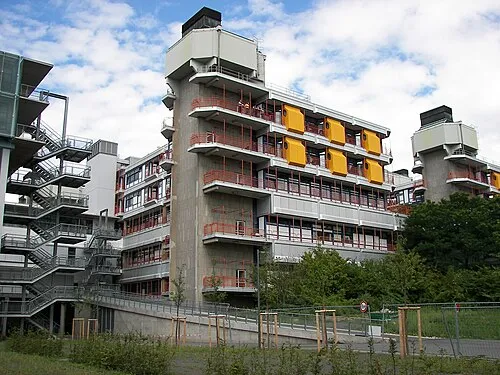

Philipps-Universität Marburg is a long-established public university in Hesse, founded in 1527, in a town where students make up a large part of the population. This page first explains the route for applicants whose German is not yet sufficient, then language certificates, the application channel and deadlines, based on the official pages.
Short answer: Marburg gives conditional admission (bedingte Zulassung) to applicants without sufficient German who apply for an admission-free programme through uni-assist, and enrols them as language students for two semesters. According to the university, this reserves the study place while you are enrolled as a language student.
Quick Facts
- University Name
- Philipps-Universität Marburg
- City
- Marburg
- State
- Hessen
- Type
- Public University
- Founded
- 1527
- Student Enrollment
- 22,612
- Official Website
- uni-marburg.de
- How to apply
- uni-assist (Bachelor's and Master's)
- Without a German certificate
- Conditional admission (admission-free programmes)
Short answer: which route is there if your German is not good enough?
According to Marburg's page on German skills, you can apply for admission-free programmes through uni-assist without German and receive conditional admission.
- You are enrolled as a language student (Sprachstudent*in) for two semesters. The university writes that conditional admission "reserves" your study place during this time.
- With proof of attendance you can continue into DSH semesters 3 and 4; re-registration for a fifth semester is not possible.
- You find and pay for the language course yourself (external or internal providers; contact: Studienkolleg Mittelhessen). The semester contribution is paid separately.
- Not for NC programmes. Changing programme or moving to an NC programme needs a new application through uni-assist.
- The Master's page refers to this option, but the official page does not state explicitly that the route covers Master's programmes; confirm before applying.
Legal framework: a residence permit for language preparation is usually granted for one year and should not exceed two years (Residence Act § 16b). To compare with other universities, see universities offering conditional admission in Germany.
Language requirement and certificate deadlines
The required DSH level depends on the programme. Certificates accepted as DSH-2 equivalents include DSD II (C1 in all parts), the Feststellungsprüfung, Goethe-Zertifikat C2 (GDS), ÖSD C2, telc Deutsch C1 Hochschule and TestDaF with at least 4 points in all parts. From summer semester 2027, combined certificates will not be accepted.
To move into the programme you were conditionally admitted to, upload the certificate in the Marvin portal by 30 September (winter semester) or 31 March (summer semester). Our guide to German language certificates compares the exams.
Application steps, deadlines and costs
- Bachelor's (foreign school certificate): admission-free programmes through uni-assist. Admission and enrolment then run through the Marvin portal.
- Master's (foreign degree): through uni-assist; deadlines vary by programme.
- Bachelor's deadlines (foreign certificate): winter semester NC 1 June – 15 July, admission-free 1 June – 15 August; summer semester NC 1 November – 15 January, admission-free 1 November – 15 February.
- Costs: Marburg charges neither tuition nor long-term study fees. The semester contribution for winter semester 2026/27 is €424.80.
- Visa: the official page makes no statement about visas; conditional admission is not a visa guarantee.
English-taught Master's examples
Marburg also offers Master's programmes taught in English. Two examples whose official pages list English as the language of instruction:
The conditional admission route is described for German-taught programmes; English-taught programmes set their own language requirements.
Marburg: The City and Student Accommodation
Marburg is a charming university city of about 75,000 residents, located in the heart of Germany, in the state of Hessen. A significant portion of its population consists of students, giving the city a youthful and dynamic vibe. With its narrow medieval streets, historic buildings, and the tranquil flow of the Lahn River, Marburg offers an inspiring environment for both academic study and social life.
One of the most frequently asked questions among students in our forums and Telegram groups is "where to live in Marburg," a crucial planning step for every student. Accommodation options in Marburg include student dormitories managed by the Studentenwerk (student services organization), shared student apartments (known as a WG, short for Wohngemeinschaft), and private apartments. Student dorms are usually the most affordable option, but spots are limited, so you need to apply early. WGs offer a more social environment and help reduce rent costs. Starting your search for accommodation in Marburg as early as possible is very important, especially around the start of the semester. The official websites of the university and the Studentenwerk are the first places you should check for housing.
Academic Structure and Diversity
Philipps-Universität Marburg offers a wide academic spectrum with its 16 different faculties (Fachbereiche). While the university's facilities are spread across the city of Marburg, there's still a strong sense of a central campus. Alongside traditional fields like Medicine, Law, Social Sciences, Natural Sciences, and Theology, the university also offers modern and interdisciplinary programs. With a total of 208 programs (92 bachelor's, 81 master's), you'll find a wealth of options to match your interests. The university is also known for its research-oriented approach, offering students opportunities to participate in various research projects.
Despite its Protestant origins in 1527, Philipps-Universität Marburg is now a completely secular public university, open to students of all faiths and backgrounds. This rich history reflects the university's academic tradition and intellectual depth, combining with a modern educational philosophy to provide you with a contemporary learning environment.
Estimated Monthly Cost of Living
Places to Visit and Student Hangouts
A historic castle and museum towering over the city, offering magnificent views.
The historic heart of the university, home to many faculties and libraries.
One of Germany's first Gothic churches and an important pilgrimage site.
The city center, a meeting point with its historic town hall and lively cafes.
Offers modern study spaces and a vast collection of resources for students.
Ideal green spaces for relaxing, walking, or cycling.
Student Life and Culture
Thanks to its high student population, Marburg boasts a vibrant and dynamic student culture. Cafes, bars, and restaurants throughout the city are usually bustling with students. The university's student representations (AStA) and various student clubs organize cultural, social, and sports events throughout the year. These events offer great opportunities for international students to integrate into the city and university.
While Marburg's hilly geography makes cycling a bit challenging, the public transport network within the city is very well developed. Your student ID comes with a Semesterticket (semester public transport pass), which allows you to use public transportation throughout the state of Hessen for free. This significantly helps your budget. University sports (Hochschulsport) also offer a wide range of physical activities for students to participate in.
- Lively cafe and bar culture
- Extensive network of student clubs and communities
- Free public transport across Hessen with your Semesterticket
- Diverse activity options with university sports (Hochschulsport)
- Life intertwined with historical and natural beauty
Frequently Asked Questions
Does the University of Marburg offer conditional admission? ▼
Yes, for applicants without sufficient German who apply for admission-free programmes through uni-assist. You are enrolled as a language student for two semesters, and the university says your place is reserved during that time. The route does not apply to NC programmes.
Does the university run the language course, and is it paid? ▼
You register for the course yourself and pay for it; there are external and internal providers, and the contact is Studienkolleg Mittelhessen. The semester contribution is paid separately.
By when must I hand in the language certificate? ▼
For the programme you were conditionally admitted to, upload it in Marvin by 30 September for a winter semester or 31 March for a summer semester. The required DSH level depends on the programme.
Does Marburg charge tuition fees? ▼
No. According to the official page, Marburg charges neither tuition nor long-term study fees. The semester contribution for winter semester 2026/27 is €424.80.
Next step: browse the admission-free programmes in the programmes tab on this page and confirm the scope on Marburg's official page on German skills. For other universities, see our conditional admission comparison.
Philipps-Universität Marburg — Gallery
Useful Links
Location

Programs & Departments
318 active programs · 103 NC-frei
This list shows the programmes in our catalogue and may be incomplete. Check the official programme page for the current list and the language of instruction.
Showing 49–72 of 318 programs
Bachelor
Mathematics Bachelor
DEBachelor of Science (B.Sc.)
The Mathematics bachelor's program in Marburg is based on a clearly developed study program. The objective is to impart a broad theoretical foundation of mathematical knowledge in connection with the...
View details →Mathematics Combined Bachelor
DEBachelor of Arts (B.A.)
Studying the minor subject "Mathematics" will enable you to work analytically and logically and to apply quantitative methods. You will be able to use mathematical methods to develop models and proced...
View details →Media Studies Combined Bachelor
DEBachelor of Arts (B.A.)
The Media Studies major covers the audiovisual media of film and photography, radio, television and digital media (computer, internet, multimedia configurations, mobile and social media). Students wil...
View details →Middle Eastern Languages Combined Bachelor
DEBachelor of Arts (B.A.)
In the four-semester minor subject "Middle Eastern Languages", you can acquire basic language skills in the modern spoken languages of the Middle East: Arabic, Persian or Turkish. You can supplement t...
View details →Middle Eastern Politics Combined Bachelor
DEBachelor of Arts (B.A.)
This course offers a combination of language, regional and methodological skills unparalleled in Germany. Fundamental political science knowledge is combined with a regional focus on the Middle East a...
View details →Middle Eastern Politics, Cultures and Economics Combined Bachelor
DEBachelor of Arts (B.A.)
Analyse developments in the Middle East, combining the methods of political science, cultural studies and economics. In this minor subject, this interdisciplinary approach will give you a multi-perspe...
View details →Middle Eastern Studies Bachelor
DEBachelor of Arts (B.A.)
The objective of the four-year "Middle Eastern Studies (international)" Bachelor's program is to acquire broad fundamental knowledge of the countries of the Near and Middle East and to acquire experti...
View details →Middle Eastern Studies Combined Bachelor
DEBachelor of Arts (B.A.)
After completing the degree programme, you will be able to understand and present the cultural diversity of the Middle East. You will learn one of the three modern languages of the region (Turkish, Pe...
View details →Modern German Literature Combined Bachelor
DEBachelor of Arts (B.A.)
In the "Modern German Literature" minor subject, you will learn fundamental skills in the systematically diversified core subject of modern German literary studies. After completing the programme, you...
View details →Modern History Combined Bachelor
DEBachelor of Arts (B.A.)
In this minor subject, you will acquire the ability to explain and discuss key structures and processes of modern history. Studying various kinds of primary source (textual sources, oral sources, pict...
View details →Movement and Sport Science Bachelor
DEBachelor of Arts (B.A.)
The Movement and Sport Science bachelor program combines fundamental competencies from theoretical fields of sports science with practical kinesiological approaches in the societal action fields of ki...
View details →Musicology Combined Bachelor
DEBachelor of Arts (B.A.)
After completing the minor, you will be able to identify key situations in older and more recent music history and place individual events, works and personalities in these contexts. Furthermore, you...
View details →North American Studies Combined Bachelor
DE+ENBachelor of Arts (B.A.)
The Bachelor's program in North American Studies explores the complex literatures and cultures of North America, specifically the United States of America and Canada. Students are offered an active an...
View details →Peace and Conflict Studies Combined Bachelor
DE+ENBachelor of Arts (B.A.)
The minor offers an introduction to the issues and principles of peace and conflict studies. This degree programme is practical throughout. The Marburg approach is characterised by interactive learnin...
View details →Philosophy Combined Bachelor
DEBachelor of Arts (B.A.)
The Philosophy minor at Philipps-Universität Marburg gives students a deep insight into the fundamentals of philosophy. After a broad introduction to ethics, theoretical philosophy, history and logic,...
View details →Physics and AI Bachelor
DEBachelor of Science (B.Sc.)
The Bachelor's degree programme "Physics and AI" aims to combine the working methods of physics with methods of computer-aided data collection, analysis and interpretation with the use of artificial i...
View details →Physics and Economics Bachelor
DE+ENBachelor of Science (B.Sc.)
The Bachelor's program in Physics and Economics is directed specifically at students interested in combining natural sciences with economics. It provides a broad foundation of expertise in the areas o...
View details →Physics Bachelor
DEBachelor of Science (B.Sc.)
Physics is the basis of all natural science, and the course of study is correspondingly broad. A 4-semester fundamental education, which includes experimental and theoretical physics, internships and...
View details →Physics of Green Technologies Bachelor
DEBachelor of Science (B.Sc.)
The Physics of Green Technologies (B.Sc.) degree course combines a solid physics education with extensive insights into a wide range of scientific disciplines in 8 semesters. Since no modern project o...
View details →Political Science Combined Bachelor
DEBachelor of Arts (B.A.)
The Marburg political science major provides fundamental knowledge of political science and the ability to work independently as a scientist using the appropriate methods. The aim of political science...
View details →Pre-Historic Archaeology Combined Bachelor
DEBachelor of Arts (B.A.)
This minor subject provides insight into contents and methods of pre-historic archaeology, from the first man in the early Stone Age to the early Middle Ages. Students acquire a thorough grounding in...
View details →Pre-Modern History Combined Bachelor
DEBachelor of Arts (B.A.)
In this minor subject, you will study the connections between the pre-modern period (ancient world, Middle Ages, early modern era) and the world of today and be able to discuss them from an academic p...
View details →Protestant Theology Bachelor
DEBachelor of Arts (B.A.)
The Bachelor's degree programme in Protestant Theology offers the opportunity to explore Christianity from an academic perspective – from its biblical roots to its role in the church, culture and soci...
View details →Protestant Theology Combined Bachelor
DEBachelor of Arts (B.A.)
The minor subject "Protestant Theology" provides the opportunity to acquire a basis for a scientifically substantiated study of the contents and objects of Protestant Theology. As well as discovering...
View details →
Marburg
State: Hesse
Study in Marburg: Established Universities and Diverse Programs
Marburg stands out as one of Germany's oldest and most established university towns (Universitätsstadt). The city is home to a total of 3 universities...
more →Accommodation in Marburg: Student Dorms and Shared Apartments (WG)
One of the most critical topics for students looking to study in Germany, especially in popular student cities like Marburg, is finding accommodation....
more →Student Life and Culture
Marburg is a true 'University City,' with students making up a significant portion of its population. This directly reflects in the city's social and...
more →More about Marburg
Cost of living, housing, transport, student life and all universities.
Student Experiences
Share yours too →No experience shared yet.
Be the first to share an experience about Philipps-Universität Marburg and help other students.
Share your experienceOther universities in Marburg
All →
Student Reviews
Verified reviews from current students, alumni and applicants.
No reviews yet. Be the first!
Verified students and alumni can share their experience below.