Germany Student Statistics 2026: International Students and Türkiye
Numbers of international students in Germany, the year-on-year change among students with Turkish citizenship, English-taught programmes, federal states, visa and graduation indicators in one place.
Advertising space
Reach students planning their studies in Germany
Book this placement — Turkish, German and English audiences
Advertise with usReport prepared by: the ApplyToGerman Team. The full report (PDF) is in Turkish.
In the 2024/25 winter semester, 402,083 international students were enrolled in higher education in Germany. The number of international students with Turkish citizenship was 20,900 in the same semester and rose to 24,171 in the 2025/26 update included in the report. For English-taught options, the July 2025 figures show 1,928 Master's and 424 Bachelor's programmes. Together, these numbers make Germany's international higher-education landscape and its educational ties with Türkiye visible from several angles.123
The Germany Student Statistics Report 2026, prepared by the ApplyToGerman team, brings together student numbers, levels of study, subject and federal-state distributions, and student mobility between Türkiye and Germany. This article presents the report's key findings in web-readable tables with explanations.
Data periods: The 2026 in the title is the report's publication frame. Most Germany-wide student data refers to the 2024/25 winter semester, the update on Turkish citizens to the 2025/26 winter semester, the English-taught programme counts to July 2025, and the UNESCO mobility data to 2023. Each section should be read with its own period in mind.45
1. How many international students are there in Germany?
In the 2024/25 winter semester, the 402,083 international students enrolled at German higher-education institutions made up 14.0% of all higher-education students in the country. Of this group, 270,357 were enrolled at universities and other institutions with university status, and 131,726 at universities of applied sciences.1
International student here means the Bildungsausländer group in the Destatis and Wissenschaft weltoffen classification: students who are not German citizens and who obtained their higher-education entrance qualification abroad or through a Studienkolleg in Germany. It is not the same as all foreign citizens studying in Germany.1
The largest group is Master's students
| Level of study | Number of students | Share of international students |
|---|---|---|
| Master's | 187,907 | 46.7% |
| Bachelor's | 138,556 | 34.5% |
| Doctorate | 31,995 | 8.0% |
| Other degree types | 18,447 | 4.6% |
| Not aiming for a degree in Germany / temporary study | 25,178 | 6.3% |
Period: 2024/25 winter semester. Source: Wissenschaft weltoffen kompakt 2026, Figure 11; report p. 3.
Master's students make up roughly half of the international student body. This table shows students enrolled in the given semester, not new applicants or graduates of that year. "Other degree types" covers programmes outside Bachelor's/Master's, such as the Staatsexamen. The temporary-study group covers enrolments such as exchange or guest students who do not aim to complete a full degree in Germany.16
Engineering and social sciences stand out
In the same semester, 171,619 international students were enrolled in engineering and 101,898 in the law, economics and social sciences group. The shares of these fields are 42.7% and 25.3% respectively. Mathematics and natural sciences had 47,757 students (11.9%) and the humanities 33,330 (8.3%). Medicine and health sciences, the arts, and agriculture and related fields are also shown separately in the report. This distribution covers all international students; the subject distribution specific to Türkiye is covered separately below.7
2. How many English-taught Bachelor's and Master's programmes are there in Germany?
The July 2025 figures in the report show that English-taught options differ considerably in size at Bachelor's and Master's level:
| Indicator | Number of English-taught programmes | Share of English-taught programmes among all programmes at that degree level |
|---|---|---|
| Master's | 1,928 | 18.4% |
| Bachelor's | 424 | 4.2% |
Period: July 2025. Source: HRK Higher Education Compass / DZHW calculations; Wissenschaft weltoffen kompakt 2026, Figures 36–37; report p. 6.
The report notes that between 2024 and 2025 the number of English-taught Bachelor's programmes grew by 16% and the number of English-taught Master's programmes by 8%. In this data set, English-taught Master's options are therefore far more numerous, while Bachelor's programmes saw the higher one-year relative growth.3
These are published programme figures for July 2025; they are not the number of entries in the ApplyToGerman catalogue, nor the number of programmes open for applications today. The programme-count table also does not show which language certificates individual programmes accept or what their admission requirements are.
For current programme options: list of English-taught Bachelor's and Master's programmes · guide to an English-taught Master's without German.
The share of English-taught provision also varies by field. For selected fields, the report gives the share of English-taught programmes as 23.8% in agriculture and forestry, 21.2% in mathematics and natural sciences, 19.3% in economics and law, and 13.2% in engineering. These percentages are not the distribution of English-taught programmes among themselves; they are the share of programmes offered in English within all programmes of each field.3
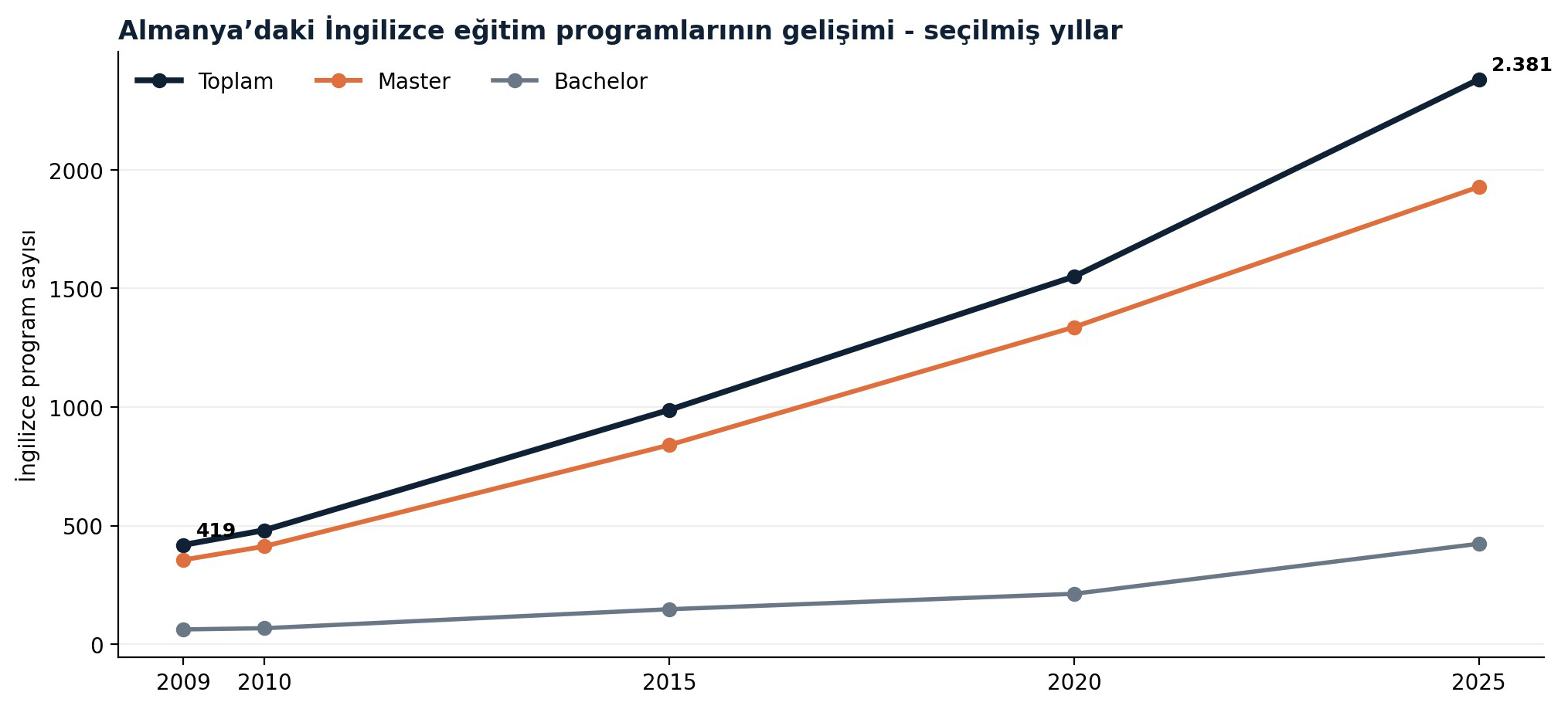
ApplyToGerman Team, Germany Student Statistics Report 2026, p. 6; HRK Higher Education Compass / DZHW. The chart is reproduced from the Turkish report; the July 2025 figures are given in the table above.
3. Which countries' citizens are the international students?
In the 2024/25 winter semester, citizens of India, China and Türkiye formed the three largest groups of international students in Germany.
| Citizenship | Number of international students | Share of the 402,083 total |
|---|---|---|
| India | 58,833 | 14.6% |
| China | 38,989 | 9.7% |
| Türkiye | 20,900 | 5.2% |
| Iran | 17,248 | 4.3% |
| Austria | 15,732 | 3.9% |
| Pakistan | 12,646 | 3.1% |
Period: 2024/25 winter semester. Source: Wissenschaft weltoffen kompakt 2026, Figure 10; report p. 8.
Türkiye is the third-largest citizenship group in this semester. "Country of origin" here is determined by the student's citizenship; it does not show in which country the student lived immediately before coming to Germany. This ranking also refers to a different period from the 2025/26 update on Türkiye below.8
4. How many students with Turkish citizenship are there in Germany?
The answer depends on which group of students is counted. In the 2025/26 winter semester, 36,807 foreign students with Turkish citizenship were enrolled at German higher-education institutions. Of this total, 24,171 were Bildungsausländer and 12,636 Bildungsinländer.5
Bildungsausländer are international students who obtained their higher-education entrance qualification outside Germany or through a Studienkolleg. Bildungsinländer are Turkish citizens who obtained that qualification in Germany. Students in the second group did not necessarily come from Türkiye to Germany in order to study.5
The international student group grew by 15.7% in one year
| Indicator | 2024/25 | 2025/26 | Year-on-year change |
|---|---|---|---|
| All foreign students with Turkish citizenship | 35,737 | 36,807 | +3.0% |
| Bildungsausländer / international students | 20,900 | 24,171 | +15.7% |
| Bildungsinländer | 14,837 | 12,636 | −14.8% |
Source: Destatis, Statistik der Studierenden, 2024/25 and 2025/26 winter semesters; report pp. 14–15.
The increase in the total number of students was 1,070 people, while the increase in the international student group was 3,271 people. The share of Bildungsausländer among all foreign students with Turkish citizenship also rose from 58.5% to 65.7%. The comparative chart on page 15 of the report shows this difference clearly: the limited growth of the total does not, on its own, tell the story of the two sub-groups moving in opposite directions.2
The increase is also visible over the longer term. The number of international students with Turkish citizenship was recorded as 6,701 in 2013/14, 10,018 in 2020/21, 18,084 in 2023/24 and 20,900 in 2024/25. These are the numbers of students enrolled in each semester, not of people newly arriving in Germany in a given year.9
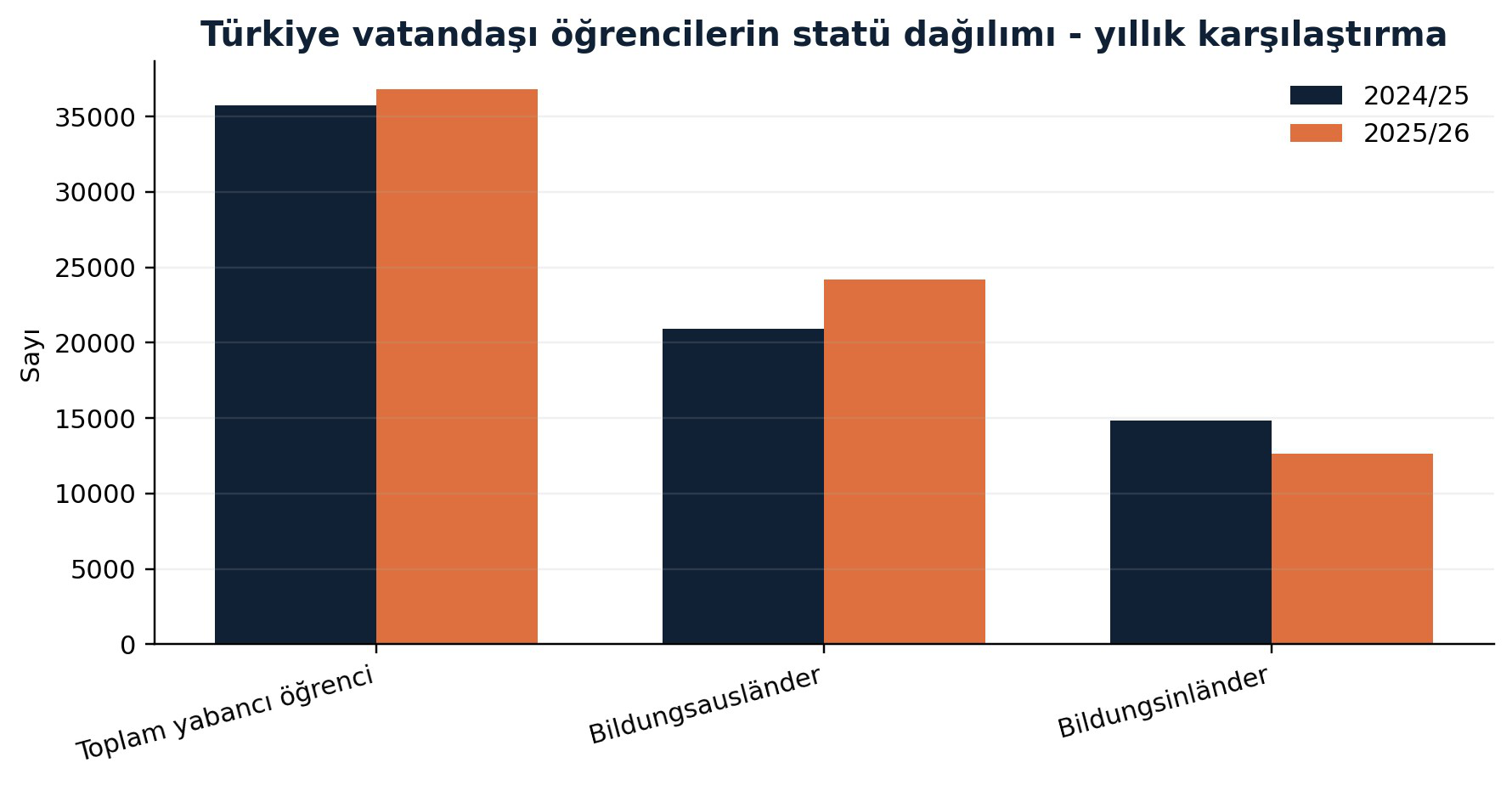
ApplyToGerman Team, report p. 15; Destatis, Statistik der Studierenden. The chart is reproduced from the Turkish report; the figures are given in the table above.
How many students are just starting?
In 2025/26, the Turkish-citizen Bildungsausländer group included 6,199 students in their first semester in the German higher-education system. In the previous semester the same indicator was 5,290; the increase is roughly 17.2%.10
Two Destatis concepts matter here: 1. Hochschulsemester is the first semester in the German higher-education system; 1. Fachsemester is the first semester in the current degree programme. Someone who previously studied in another programme in Germany can start a first Fachsemester in a new programme. Counting students in the first semester of a programme is therefore not the same as counting those new to the system.2
5. What do students with Turkish citizenship study?
In the 2025/26 data, engineering ranks first with 16,037 students. This table covers all 36,807 foreign students with Turkish citizenship, not only the 24,171 international students.
| Field of study | Number of students | Share of the 36,807 total |
|---|---|---|
| Engineering | 16,037 | 43.6% |
| Economics | 5,915 | 16.1% |
| Social and behavioural sciences + sport | 3,860 | 10.5% |
| Mathematics and natural sciences | 3,600 | 9.8% |
| Humanities | 3,330 | 9.0% |
| Law and public administration | 1,717 | 4.7% |
| Medicine and health sciences | 1,116 | 3.0% |
| Art and art studies | 857 | 2.3% |
| Agriculture, forestry, food and veterinary science | 267 | 0.7% |
| Other | 108 | 0.3% |
Period: 2025/26 winter semester. Source: Destatis, citizenship × field of study table; report pp. 16–17.
Engineering accounts for 43.6% of foreign students with Turkish citizenship. This broad distribution alone does not reveal the ranking of individual subjects such as computer, mechanical or civil engineering. In addition, the 2024/25 and 2025/26 field classifications are not identical, especially for law, economics and social sciences; year-on-year change should not be calculated by treating these categories as directly equivalent.1112
By type of institution, 24,933 of the same group were enrolled at universities (67.7%) and 11,362 at universities of applied sciences / Fachhochschulen (30.9%). This distinction describes the academic type of institution; it is not a private-versus-public split.13
6. In which federal states are students concentrated?
For all international students in the 2024/25 winter semester, North Rhine-Westphalia ranks first with 81,954 students, followed by Bavaria: 72,483, Berlin: 42,721, Baden-Württemberg: 37,917 and Hesse: 32,596. Among the states listed, the highest share of international students within the state's total student body is Berlin at 21.3%.14
The separate table showing the link to Türkiye is based not on citizenship but on the higher-education entrance qualification (HZB) having been obtained in Türkiye. In the 2023/24 winter semester, 18,126 international students met this definition; the table does not include doctoral students.15
| Federal state | Students with a Türkiye-obtained HZB | Share of the 18,126 group |
|---|---|---|
| Bavaria | 4,804 | 26.5% |
| North Rhine-Westphalia | 4,199 | 23.2% |
| Berlin | 2,183 | 12.0% |
| Baden-Württemberg | 1,633 | 9.0% |
| Hesse | 1,480 | 8.2% |
Period: 2023/24 winter semester. Source: Destatis, Nichtmonetäre hochschulstatistische Kennzahlen 1980–2024, table 21381-08; report pp. 18–20.
These five states together account for 14,299 students, roughly 78.9% of the Türkiye-HZB group. This is a distribution by federal state; we do not conclude from it which city or university students from Türkiye choose most often.1612
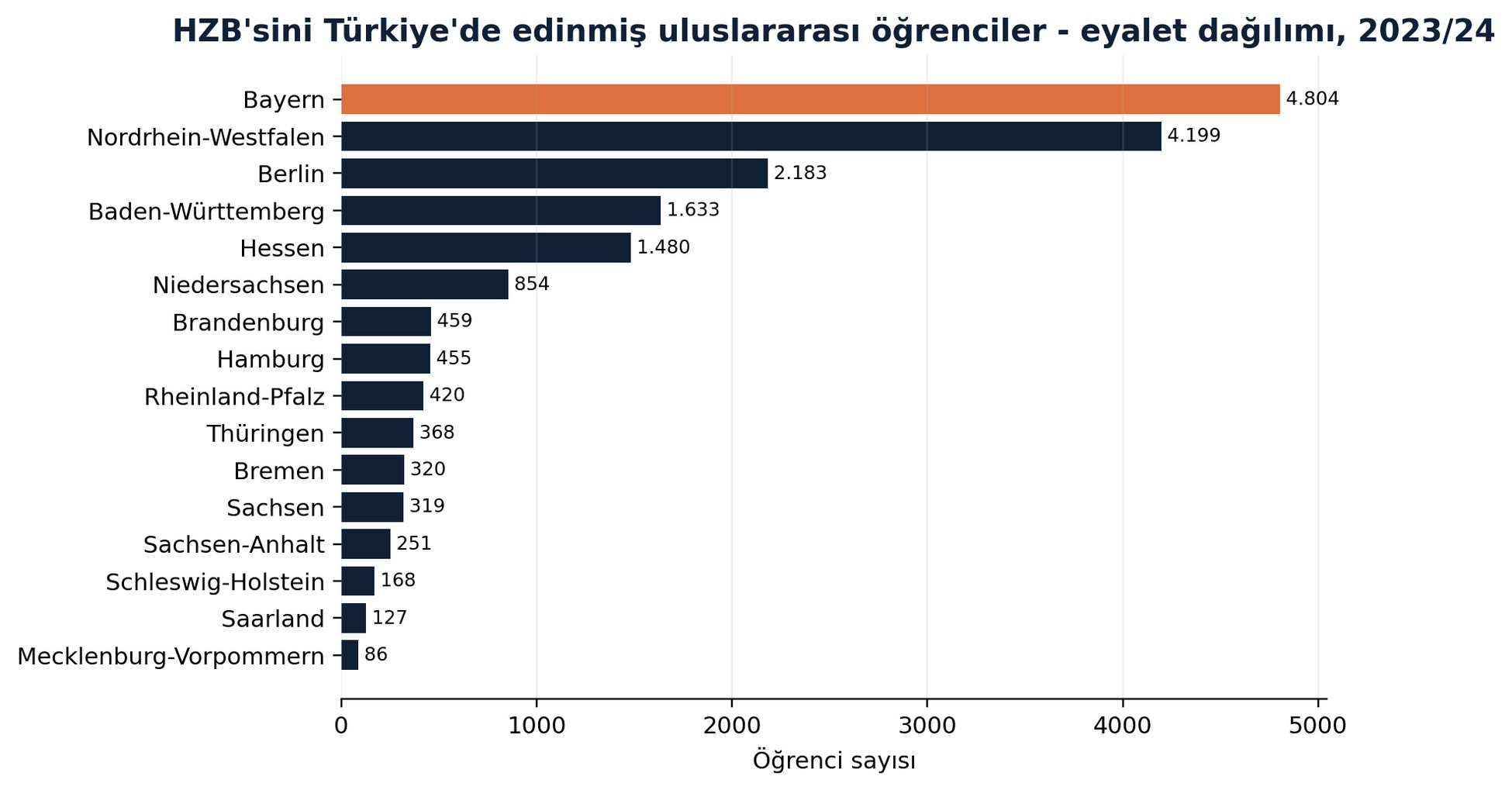
ApplyToGerman Team, report p. 19; Destatis, table 21381-08. The chart is reproduced from the Turkish report and shows all 16 states; the five largest are given in the table above.
7. Germany's place for students from Türkiye studying abroad
According to UNESCO's 2023 degree mobility data, 66,914 students from Türkiye were in higher education in another country with the aim of completing a degree there. This indicator excludes Erasmus, guest study and similar temporary mobility.17
| Country of study | Number of students | Share of degree-mobile students from Türkiye |
|---|---|---|
| Germany | 16,585 | 24.8% |
| United States | 7,951 | 11.9% |
| United Kingdom | 5,406 | 8.1% |
| Italy | 5,398 | 8.1% |
| North Macedonia | 3,384 | 5.1% |
The table shows the five main countries of study; the total is not limited to these countries. Source: Wissenschaft weltoffen interactive / UNESCO, degree mobility 2023; report pp. 11–12.
In this data set, Germany hosts roughly a quarter of the students from Türkiye who are abroad for degree study. In the same UNESCO series, the number in Germany rose from 5,615 in 2016 to 16,585 in 2023. This series and the Destatis figure of 24,171 for 2025/26 differ in period and student definition; they should not be used as two consecutive annual values.1819
8. Student enrolment, study visas and residence permits are not the same number
Enrolled students, study-related visa procedures and study-related residence permits are measured by different institutions. These data show different aspects of educational mobility; they do not form a single table counting the same people with the same method.20
Study-related visa procedures at German missions in Türkiye
| Visa procedure category | 2024 | 2025 | Change |
|---|---|---|---|
| University study + preparation + application | 9,829 | 10,369 | +5.5% |
| Language course + school education | 970 | 1,303 | +34.3% |
Source: Auswärtiges Amt, Bearbeitete nationale Visa 2024 and 2025; sum of the Ankara, Istanbul and Izmir rows; report pp. 23–24.
The "Studium" category covers preparatory study and university application in addition to university study. The 1,303 procedures are not language courses alone; they are the category combining language courses and school education. These procedure counts do not show the number of unique students who actually entered Germany, nor a visa approval rate.2122
Study-related residence permits
In the BAMF data, 4,285 Turkish citizens received a study-related residence permit for the first time in 2024 without holding any previous residence permit in the AZR register. Of these, 3,515 were in the university study / university preparation group and 770 in other educational purposes. The report explains this indicator as a close measure of new educational migration, not directly as the number of all students arriving from Türkiye that year.20
In a separate stock indicator, the number of Turkish citizens holding a study-related residence permit as of 31 December 2024 was 14,190. This total may include not only university students but also other educational purposes. Because not all sub-purposes are reported separately for Türkiye, the exact size of the language-course or vocational-training group cannot be calculated from it.23
9. What do the graduation and doctoral data show?
Destatis's 2024 examination statistics record 4,955 successfully passed final examinations by Turkish citizens. This data counts examination events that complete a programme, not student enrolments.
| Degree / type of completion | Successful final examinations |
|---|---|
| Master's | 2,197 |
| Bachelor's | 2,096 |
| Teacher training / Lehramt | 335 |
| Doctorate / Promotion | 202 |
| Other university completion types | 125 |
| Total | 4,955 |
Period: 2024 examination year. Source: Destatis, Statistik der Prüfungen; report p. 25.
Among foreign citizenship groups, Turkish citizens rank first in the number of successful examinations leading to a Bachelor's degree and third for Master's. This is a ranking by absolute number of examinations, not a success rate. For the same reason, we do not describe the 4,955 examinations as 4,955 unique graduates.24
The 2025 doctoral statistics show 2,315 doctoral candidates with Turkish citizenship. Of these, 701 (30.3%) are in structured doctoral programmes and 1,614 (69.7%) outside such programmes. This statistic covers people whose acceptance as doctoral candidates has been confirmed in writing; it is not the same as an indicator counting only doctoral students enrolled at a university. A completion rate cannot be calculated from the 202 doctoral examinations in 2024 and the number of candidates in 2025.25
10. Which questions does this report not answer?
The report shows the distribution of Turkish citizens across broad fields of study and institution types. However, a separate stock breakdown of current students with Turkish citizenship by Bachelor's, Master's and doctoral level is not included in this compilation. Applying the Germany-wide Master's share of 46.7% to Turkish citizens does not fill this gap.2612
Likewise, no ranking of the universities or cities most chosen by students from Türkiye has been produced. The GENESIS institution table in the report covers all foreign students, and some institutions appear in separate rows by campus or registration unit. Presenting that table as "the universities Turkish students prefer most" would therefore be incorrect.2712
The private-versus-public university split, the exact number of Turkish citizens attending only a language course, and subject-level breakdowns specific to Türkiye are also not available separately in this report. Fields without data have not been filled in with another group's ratio or with estimates.12
Conclusion: definitions and periods matter as much as the numbers
The report brings together three distinct pictures: the weight of Master's study in Germany's international student body, the rise in the number of Bildungsausländer with Turkish citizenship, and the prominence of engineering in the subject distribution of foreign students with Turkish citizenship. English-taught programmes, federal states and the study-related visa and residence indicators complete this picture.6211
These data can be read together, but they cannot be merged into a single total. Enrolled students, new entrants, visa procedures, residence permits and successful final examinations are different indicators. The ApplyToGerman Germany Student Statistics Report 2026 aims to present educational mobility clearly while preserving these distinctions.28
For the steps of the application process: Doing a Master's in Germany: A–Z guide.
Sources and method
This article is the web publication of the Germany Student Statistics report prepared by the ApplyToGerman Team. The report was prepared in September 2026. The numbers and percentages in the tables are reproduced as they appear in the report; the scope of the selected-country, federal-state or level-of-study tables is stated in the relevant section.4
Germany overall and English-taught programmes: DAAD/DZHW, Wissenschaft weltoffen kompakt 2026, second revised version, June 2026; HRK Higher Education Compass and DZHW calculations.
Student enrolments, Turkish citizens and federal states: Destatis, Statistik der Studierenden 2024/25 and 2025/26; Nichtmonetäre hochschulstatistische Kennzahlen 1980–2024, table 21381-08; the relevant GENESIS student tables.
International degree mobility: UNESCO student mobility data via Wissenschaft weltoffen Interactive, 2023.
Study-related residence and visa procedures: BAMF, Monitoring zur Bildungs- und Erwerbsmigration — Jahresbericht 2024 and its table annex; Auswärtiges Amt, Bearbeitete nationale Visa 2024 and 2025.
Final examinations and doctoral candidates: Destatis, Statistik der Prüfungen — Prüfungsjahr 2024 and Statistik der Promovierenden 2025. The source list in the report documents these indicator groups together with the limits of comparison.29
Download the full statistics report as a PDF (in Turkish, 1.6 MB)
Source notes within the report
ApplyToGerman Team, Almanya Öğrenci İstatistikleri (Germany Student Statistics, in Turkish), September 2026, p. 2. The underlying institutional sources are listed in the sources section of this article and in the original report. ↩ ↩ ↩ ↩
ApplyToGerman Team, Almanya Öğrenci İstatistikleri (Germany Student Statistics, in Turkish), September 2026, p. 15. The underlying institutional sources are listed in the sources section of this article and in the original report. ↩ ↩ ↩ ↩
ApplyToGerman Team, Almanya Öğrenci İstatistikleri (Germany Student Statistics, in Turkish), September 2026, p. 6. The underlying institutional sources are listed in the sources section of this article and in the original report. ↩ ↩ ↩
ApplyToGerman Team, Almanya Öğrenci İstatistikleri (Germany Student Statistics, in Turkish), September 2026, p. 1. The underlying institutional sources are listed in the sources section of this article and in the original report. ↩ ↩
ApplyToGerman Team, Almanya Öğrenci İstatistikleri (Germany Student Statistics, in Turkish), September 2026, p. 14. The underlying institutional sources are listed in the sources section of this article and in the original report. ↩ ↩ ↩
ApplyToGerman Team, Almanya Öğrenci İstatistikleri (Germany Student Statistics, in Turkish), September 2026, p. 3. The underlying institutional sources are listed in the sources section of this article and in the original report. ↩ ↩
ApplyToGerman Team, Almanya Öğrenci İstatistikleri (Germany Student Statistics, in Turkish), September 2026, pp. 3–4. The underlying institutional sources are listed in the sources section of this article and in the original report. ↩
ApplyToGerman Team, Almanya Öğrenci İstatistikleri (Germany Student Statistics, in Turkish), September 2026, p. 8. The underlying institutional sources are listed in the sources section of this article and in the original report. ↩
ApplyToGerman Team, Almanya Öğrenci İstatistikleri (Germany Student Statistics, in Turkish), September 2026, pp. 9–10. The underlying institutional sources are listed in the sources section of this article and in the original report. ↩
ApplyToGerman Team, Almanya Öğrenci İstatistikleri (Germany Student Statistics, in Turkish), September 2026, p. 16. The underlying institutional sources are listed in the sources section of this article and in the original report. ↩
ApplyToGerman Team, Almanya Öğrenci İstatistikleri (Germany Student Statistics, in Turkish), September 2026, pp. 16–17. The underlying institutional sources are listed in the sources section of this article and in the original report. ↩ ↩
ApplyToGerman Team, Almanya Öğrenci İstatistikleri (Germany Student Statistics, in Turkish), September 2026, p. 30. The underlying institutional sources are listed in the sources section of this article and in the original report. ↩ ↩ ↩ ↩ ↩
ApplyToGerman Team, Almanya Öğrenci İstatistikleri (Germany Student Statistics, in Turkish), September 2026, pp. 17–18. The underlying institutional sources are listed in the sources section of this article and in the original report. ↩
ApplyToGerman Team, Almanya Öğrenci İstatistikleri (Germany Student Statistics, in Turkish), September 2026, p. 4. The underlying institutional sources are listed in the sources section of this article and in the original report. ↩
ApplyToGerman Team, Almanya Öğrenci İstatistikleri (Germany Student Statistics, in Turkish), September 2026, p. 18. The underlying institutional sources are listed in the sources section of this article and in the original report. ↩
ApplyToGerman Team, Almanya Öğrenci İstatistikleri (Germany Student Statistics, in Turkish), September 2026, pp. 19–20. The underlying institutional sources are listed in the sources section of this article and in the original report. ↩
ApplyToGerman Team, Almanya Öğrenci İstatistikleri (Germany Student Statistics, in Turkish), September 2026, p. 11. The underlying institutional sources are listed in the sources section of this article and in the original report. ↩
ApplyToGerman Team, Almanya Öğrenci İstatistikleri (Germany Student Statistics, in Turkish), September 2026, p. 12. The underlying institutional sources are listed in the sources section of this article and in the original report. ↩
ApplyToGerman Team, Almanya Öğrenci İstatistikleri (Germany Student Statistics, in Turkish), September 2026, p. 13. The underlying institutional sources are listed in the sources section of this article and in the original report. ↩
ApplyToGerman Team, Almanya Öğrenci İstatistikleri (Germany Student Statistics, in Turkish), September 2026, p. 21. The underlying institutional sources are listed in the sources section of this article and in the original report. ↩ ↩
ApplyToGerman Team, Almanya Öğrenci İstatistikleri (Germany Student Statistics, in Turkish), September 2026, p. 23. The underlying institutional sources are listed in the sources section of this article and in the original report. ↩
ApplyToGerman Team, Almanya Öğrenci İstatistikleri (Germany Student Statistics, in Turkish), September 2026, p. 24. The underlying institutional sources are listed in the sources section of this article and in the original report. ↩
ApplyToGerman Team, Almanya Öğrenci İstatistikleri (Germany Student Statistics, in Turkish), September 2026, p. 22. The underlying institutional sources are listed in the sources section of this article and in the original report. ↩
ApplyToGerman Team, Almanya Öğrenci İstatistikleri (Germany Student Statistics, in Turkish), September 2026, p. 25. The underlying institutional sources are listed in the sources section of this article and in the original report. ↩
ApplyToGerman Team, Almanya Öğrenci İstatistikleri (Germany Student Statistics, in Turkish), September 2026, pp. 26–27. The underlying institutional sources are listed in the sources section of this article and in the original report. ↩
ApplyToGerman Team, Almanya Öğrenci İstatistikleri (Germany Student Statistics, in Turkish), September 2026, p. 29. The underlying institutional sources are listed in the sources section of this article and in the original report. ↩
ApplyToGerman Team, Almanya Öğrenci İstatistikleri (Germany Student Statistics, in Turkish), September 2026, p. 5. The underlying institutional sources are listed in the sources section of this article and in the original report. ↩
ApplyToGerman Team, Almanya Öğrenci İstatistikleri (Germany Student Statistics, in Turkish), September 2026, p. 28. The underlying institutional sources are listed in the sources section of this article and in the original report. ↩
ApplyToGerman Team, Almanya Öğrenci İstatistikleri (Germany Student Statistics, in Turkish), September 2026, p. 31. The underlying institutional sources are listed in the sources section of this article and in the original report. ↩
Advertising space
Reach students planning their studies in Germany
Book this placement — Turkish, German and English audiences
Advertise with usWas this guide helpful?
Let us know what was missing via the feedback widget at the bottom right, and we will update quickly.
Share this article
About the Author

Şule Demirel
Director, Students from Türkiye
Şule Demirel is Director, Students from Türkiye at ApplyToGerman. She also works in business development at DreamToMove, a B2B partner for education agencies.
Related Articles
German University Grading System and Exam Retake Rules
German universities grade from 1.0 to 5.0, and 4.0 usually passes. But there's no national "three at...
24 min read
How the Bachelor's and Master's Thesis Works in Germany
There is no single thesis process in Germany. Learn how Bachelor and Master theses work, from findin...
23 min read
Where to Study Economics in German in Germany: From the Top Faculties to NC-Free Universities
Where to study a German-taught economics (VWL) bachelor: first the prestige order — Bonn, Mannheim,...
7 min read
Comments
Share your experience or ask a question. Comments are reviewed before publishing.