
The Contemporary Puppet Art (Zeitgenössische Puppenspielkunst) diploma program focuses on the performer as the central element. The four-year study begins with the fundamentals of acting and animation of puppets and objects. From the beginning, students learn to develop their own stories, making this program ideal for those who want to perform on stage while developing their own artistic authorship. Throughout the program, students work with different forms of puppets in scene studies. With only 10 students per year, the supervision is highly individualized, providing space for students to pursue their own artistic ideas. The university's network helps students find the right partners and establish practical connections early on. The education concludes with a diploma as a Puppeteer/Performing Artist.
The program is structured into basic studies (Grundstudium, semesters 1-5) and main studies (Hauptstudium, semesters 6-8). The basic studies focus on establishing the fundamentals of animation, puppetry, and acting, progressing from traditional puppet forms (mask, mouth puppets, marionettes) to more complex arrangements including digital media. The main studies allow students to deepen their profile and develop their own 'theater languages'. Students learn to see themselves not just as performers but as comprehensive stage artists who contribute to concepts, develop texts, incorporate partners from other art forms, and initiate creative processes. The main studies include a studio production typically created in cooperation with a theater, and in the 4th year, students develop their free diploma projects and ensemble diplomas, often in collaboration with theaters or festivals.
The curriculum includes a wide range of subjects: Animation (bringing inanimate materials to life), Digital Media (combining puppetry with virtual spaces and new technologies), Hand Puppets, Masks, Puppet Control Techniques, Speech and Voice Training, Theater History/Puppet Theater History/Dramaturgy, Acting, Movement (including acrobatics, aikido, pantomime, fencing, tap dancing, and dance), Verse Theory, Free Projects, Studio Productions, Ensemble Productions, Hybrid Forms (creating mixed puppet forms), Cultural Management (for freelance artists), Music, Puppet Building Technology, Theory of Puppet Art, Marionettes, and Design Theory.
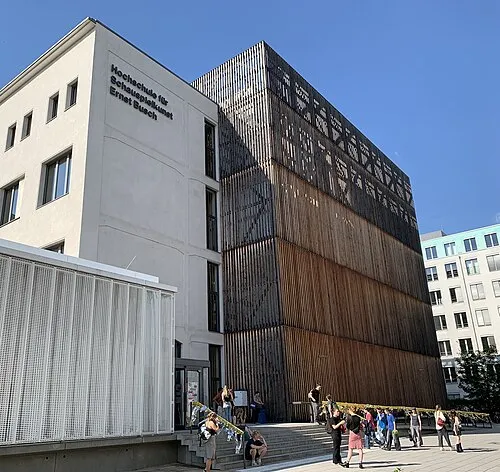
Other
German
Arts & Design
Zeitgenössische PuppenspielkunstContemporary Puppetry
Other
About the Program
General Requirements
Specific requirements for this program are not in our database yet. The following are typical for this degree and language in Germany — always verify the exact requirements on the program's official page.
Academic qualification
A recognised higher-education entrance qualification (Abitur or equivalent). International applicants may need recognition via Anabin and, if not directly eligible, a Studienkolleg + assessment exam (Feststellungsprüfung).
Language
German at C1 level (DSH-2, TestDaF TDN 4, Goethe-Zertifikat C1, or telc C1 Hochschule).
Typical documents
- Recognised diploma and transcript (certified translations)
- Language certificate
- Passport and passport photo
- Tabular CV (Lebenslauf)
- Letter of motivation (for many programs)
- Application via uni-assist / VPD (for most international applicants)
Which Professions Does This Program Open Up?
Related profession searches from Bundesagentur für Arbeit (BERUFENET) data:
Explore all professions →Subjects / Topic Areas
Puppet Art
Similar Programs
Conducting
Hochschule für Musik und Theater Hamburg
Other
Frames of Attention
Muthesius Kunsthochschule
Other
Textile Arts
Burg Giebichenstein Kunsthochschule Halle
Other
Zeichenzirkel
Muthesius Kunsthochschule
Other
Meisterklasse
Hochschule für Musik Würzburg
Other
Schriftgestaltung
Muthesius Kunsthochschule
Other
How do I apply to Zeitgenössische Puppenspielkunst at Hochschule für Schauspielkunst Ernst Busch Berlin?
Most international applicants apply via uni-assist (document verification + APS for some countries). Prepare your secondary/Bachelor diploma, transcripts, language certificate (DSH/TestDaF or IELTS/TOEFL), motivation letter and CV. Non-EU students also need a Sperrkonto (~11,904 EUR/year) for the visa.
- Check requirements — Verify your degree is recognised + meet language/grade thresholds.
- Get language certificate — TestDaF / DSH for German programmes, IELTS / TOEFL for English.
- Submit via uni-assist (non-EU) — Document review + APS if your country requires it (China, India, Pakistan, Vietnam, etc.).
- Apply directly or via uni portal — Some universities accept direct applications — check the official programme page.
- Open Sperrkonto + apply for visa — After admission, deposit 11,904 EUR, get health insurance, book embassy appointment.
Frequently Asked Questions
Quick answers about Zeitgenössische Puppenspielkunst at Hochschule für Schauspielkunst Ernst Busch Berlin
Is Zeitgenössische Puppenspielkunst at Hochschule für Schauspielkunst Ernst Busch Berlin taught in German or English? ▼
This Other programme is taught in German. Make sure to check the language requirements (e.g. TestDaF, DSH, IELTS or TOEFL) before applying.
How much does the Zeitgenössische Puppenspielkunst programme cost? ▼
No tuition fee (only semester contribution). International students should also budget around 800–1000 EUR/month for living costs in Germany.
What are the admission requirements for Zeitgenössische Puppenspielkunst at Hochschule für Schauspielkunst Ernst Busch Berlin? ▼
Typical requirements include: a recognised secondary/undergraduate degree, proof of language proficiency (German), and (for non-EU applicants) a uni-assist application plus financial proof (Sperrkonto ~11.904 EUR/year).
When is the application deadline? ▼
Application deadlines vary: winter semester usually closes on 15 July, summer semester on 15 January. Always confirm the exact deadline on the official university website.
Can I work in Germany while studying Zeitgenössische Puppenspielkunst? ▼
Yes. International students may work up to 140 working days a year without additional permission (a day of up to 4 hours counts as half a day). After graduation you can apply for an 18-month job-seeker permit.
How do I apply to Hochschule für Schauspielkunst Ernst Busch Berlin — directly or via uni-assist? ▼
Most German universities accept international applications through uni-assist for document verification. Some unis accept direct applications — check the programme page on the official site.