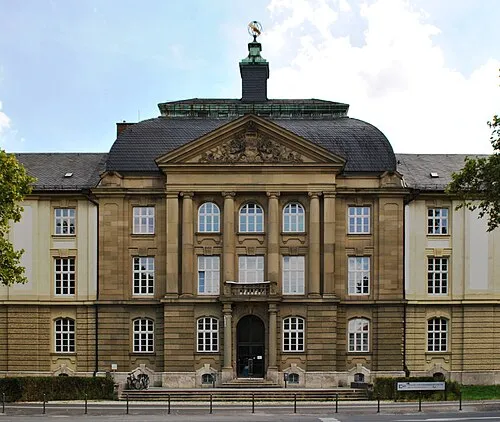
Mathematische PhysikMathematical Physics
Master of Science (M.Sc.)

About the Program
▶ Show the original English text
General Requirements
Specific requirements for this program are not in our database yet. The following are typical for this degree and language in Germany — always verify the exact requirements on the program's official page.
Academic qualification
A recognised Bachelor's degree in a related field; some programs require a minimum grade or specific prerequisites.
Language
German at C1 level (DSH-2, TestDaF TDN 4, Goethe-Zertifikat C1, or telc C1 Hochschule).
Typical documents
- Recognised diploma and transcript (certified translations)
- Language certificate
- Passport and passport photo
- Tabular CV (Lebenslauf)
- Letter of motivation (for many programs)
- Application via uni-assist / VPD (for most international applicants)
Which Professions Does This Program Open Up?
Related profession searches from Bundesagentur für Arbeit (BERUFENET) data:
Explore all professions →Subjects / Topic Areas
Similar Programs
Environmental Engineering
Rheinland-Pfälzische Technische Universität Kaiserslautern-Landau
Master of Science (M.Sc.)
Product Isolation
Hochschule Biberach
Master of Science (M.Sc.)
Mathematics international
Rheinland-Pfälzische Technische Universität Kaiserslautern-Landau
Master of Science (M.Sc.)
Mathematics
Georg-August-Universität Göttingen
Master of Science (M.Sc.)
Neurocognitive Psychology
Carl von Ossietzky Universität Oldenburg
Master of Science (M.Sc.)
Mechanical Engineering and Mathematics , M.Ed.
Technische Universität Berlin
Master of Education (M.Ed.)
How do I apply to Mathematische Physik at Julius-Maximilians-Universität Würzburg?
Most international applicants apply via uni-assist (document verification + APS for some countries). Prepare your secondary/Bachelor diploma, transcripts, language certificate (DSH/TestDaF or IELTS/TOEFL), motivation letter and CV. Non-EU students also need a Sperrkonto (~11,904 EUR/year) for the visa.
- Check requirements — Verify your degree is recognised + meet language/grade thresholds.
- Get language certificate — TestDaF / DSH for German programmes, IELTS / TOEFL for English.
- Submit via uni-assist (non-EU) — Document review + APS if your country requires it (China, India, Pakistan, Vietnam, etc.).
- Apply directly or via uni portal — Some universities accept direct applications — check the official programme page.
- Open Sperrkonto + apply for visa — After admission, deposit 11,904 EUR, get health insurance, book embassy appointment.
Frequently Asked Questions
Quick answers about Mathematische Physik at Julius-Maximilians-Universität Würzburg
Is Mathematische Physik at Julius-Maximilians-Universität Würzburg taught in German or English? ▼
This Master programme is taught in German. Make sure to check the language requirements (e.g. TestDaF, DSH, IELTS or TOEFL) before applying.
How much does the Mathematische Physik programme cost? ▼
No tuition fee (only semester contribution). International students should also budget around 800–1000 EUR/month for living costs in Germany.
What are the admission requirements for Mathematische Physik at Julius-Maximilians-Universität Würzburg? ▼
Typical requirements include: a recognised secondary/undergraduate degree, proof of language proficiency (German), and (for non-EU applicants) a uni-assist application plus financial proof (Sperrkonto ~11.904 EUR/year).
When is the application deadline? ▼
Application deadlines vary: winter semester usually closes on 15 July, summer semester on 15 January. Always confirm the exact deadline on the official university website.
Can I work in Germany while studying Mathematische Physik? ▼
Yes. International students may work up to 140 full days / 280 half days per year without additional permission. After graduation you can apply for an 18-month job-seeker permit.
How do I apply to Julius-Maximilians-Universität Würzburg — directly or via uni-assist? ▼
Most German universities accept international applications through uni-assist for document verification. Some unis accept direct applications — check the programme page on the official site.