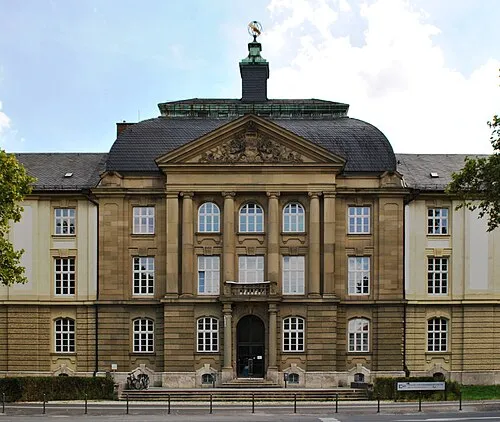
Conservation Biology and Applied Ecology
Master

About the Program
▶ Show the original English text
General Requirements
Specific requirements for this program are not in our database yet. The following are typical for this degree and language in Germany — always verify the exact requirements on the program's official page.
Academic qualification
A recognised Bachelor's degree in a related field; some programs require a minimum grade or specific prerequisites.
Language
English proficiency (typically IELTS ~6.5 or TOEFL iBT ~90). Basic German is helpful for daily life.
Typical documents
- Recognised diploma and transcript (certified translations)
- Language certificate
- Passport and passport photo
- Tabular CV (Lebenslauf)
- Letter of motivation (for many programs)
- Application via uni-assist / VPD (for most international applicants)
Which Professions Does This Program Open Up?
Related profession searches from Bundesagentur für Arbeit (BERUFENET) data:
Explore all professions →Subjects / Topic Areas
Similar Programs
Interreligious Studies
Universität Heidelberg
Master of Arts (M.A.)
Public History
Freie Universität Berlin, E-Medien
Master of Arts (M.A.)
Empirical Political and Social Research
Universität Stuttgart
Master of Arts (M.A.)
Jewish Theology
Universität Potsdam
Master of Arts (M.A.)
Mind, Brain and Behavior
Justus-Liebig-Universität Gießen
Master of Science (M.Sc.)
Vocational Education Nutritional Science and Home Economics
Hochschule Osnabrück
Master of Education (M.Ed.)
How do I apply to Conservation Biology and Applied Ecology at Julius-Maximilians-Universität Würzburg?
Most international applicants apply via uni-assist (document verification + APS for some countries). Prepare your secondary/Bachelor diploma, transcripts, language certificate (DSH/TestDaF or IELTS/TOEFL), motivation letter and CV. Non-EU students also need a Sperrkonto (~11,904 EUR/year) for the visa.
- Check requirements — Verify your degree is recognised + meet language/grade thresholds.
- Get language certificate — TestDaF / DSH for German programmes, IELTS / TOEFL for English.
- Submit via uni-assist (non-EU) — Document review + APS if your country requires it (China, India, Pakistan, Vietnam, etc.).
- Apply directly or via uni portal — Some universities accept direct applications — check the official programme page.
- Open Sperrkonto + apply for visa — After admission, deposit 11,904 EUR, get health insurance, book embassy appointment.
Frequently Asked Questions
Quick answers about Conservation Biology and Applied Ecology at Julius-Maximilians-Universität Würzburg
Is Conservation Biology and Applied Ecology at Julius-Maximilians-Universität Würzburg taught in German or English? ▼
This Master programme is taught in English. Make sure to check the language requirements (e.g. TestDaF, DSH, IELTS or TOEFL) before applying.
How much does the Conservation Biology and Applied Ecology programme cost? ▼
No tuition fee (only semester contribution). International students should also budget around 800–1000 EUR/month for living costs in Germany.
What are the admission requirements for Conservation Biology and Applied Ecology at Julius-Maximilians-Universität Würzburg? ▼
Typical requirements include: a recognised secondary/undergraduate degree, proof of language proficiency (English), and (for non-EU applicants) a uni-assist application plus financial proof (Sperrkonto ~11.904 EUR/year).
When is the application deadline? ▼
Application deadlines vary: winter semester usually closes on 15 July, summer semester on 15 January. Always confirm the exact deadline on the official university website.
Can I work in Germany while studying Conservation Biology and Applied Ecology? ▼
Yes. International students may work up to 140 full days / 280 half days per year without additional permission. After graduation you can apply for an 18-month job-seeker permit.
How do I apply to Julius-Maximilians-Universität Würzburg — directly or via uni-assist? ▼
Most German universities accept international applications through uni-assist for document verification. Some unis accept direct applications — check the programme page on the official site.