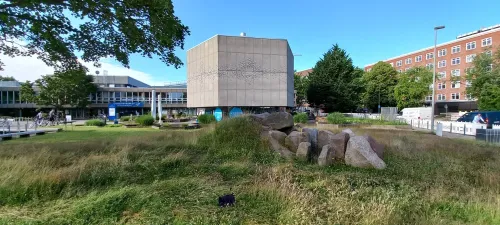

Christian-Albrechts-Universität zu Kiel
Located in Kiel, the pearl of Northern Germany, Christian-Albrechts-Universität zu Kiel (CAU) is a well-established and prestigious public university offering study in Germany opportunities for international students. Founded in 1665, this historic institution is the oldest and largest university in the state of Schleswig-Holstein. With approximately 25,000 students, CAU offers a vibrant academic environment, particularly known for its research-focused programs.
The university has proven its academic strength by hosting 12 Nobel laureates in the past. If you're looking to get a high-quality education in Germany and live in a peaceful student city by the sea, Christian-Albrechts-Universität zu Kiel could be an ideal choice for you. You can click here for the university's official website (zur website).
Quick Facts
- University Name
- Christian-Albrechts-Universität zu Kiel
- City
- Kiel
- State
- Schleswig-Holstein
- University Type
- Public Research University (Universitäten)
- Founded In
- 1665
- Student Count
- 24,936
- AlmanyaUni DB Programs
- 18 (Master)
- HRK Member
- Evet
- Uni-Assist Member
- Hayır
Christian-Albrechts-Universität zu Kiel: History and Academic Strength
Christian-Albrechts-Universität zu Kiel is named after its founder, Duke Christian Albrecht of Holstein-Gottorf, and has been continuously providing education since 1665. As the only full-fledged university in the state of Schleswig-Holstein, CAU offers a wide range of interdisciplinary programs. The university's academic structure focuses on modern research areas while also maintaining its deep-rooted traditions.
It holds a strong reputation, especially in marine sciences, life sciences, cultural and social sciences, and engineering. The university has hosted many internationally recognized scientists and has made significant contributions to the scientific world with 12 Nobel laureate alumni and researchers. This demonstrates the quality of education and research the university offers. For international students, master's programs are particularly attractive options, as the AlmanyaUni database lists 18 Master's programs.
Kiel: A Student Paradise by the Sea
Kiel is a lively port city located in northern Germany, right on the Baltic Sea. Thanks to the young and dynamic population brought by Christian-Albrechts-Universität zu Kiel, it's truly a student city. The city is deeply intertwined with maritime culture, famous for its sailing races and sea festivals.
Students can walk along the coast, bike, or engage in water sports during breaks or on weekends. Kiel also offers easy transportation connections to other major German cities and Scandinavia. The public transport network within the city is well-developed, and students can usually use public transport for free or at very low costs with their Semesterticket (semester ticket).
Searches for maps zur are quite popular for navigating to the university campus and key city spots in Kiel, reflecting the city's student-friendly nature. The city is full of cultural events, cafes, bars, and student-friendly venues, offering a warm and welcoming environment for international students.
Estimated Monthly Cost of Living
Places to Visit and Student Hangouts
The heart of Kiel, this fjord is ideal for sea views and boat tours.
Owned by the university, this garden houses various plant species and is a great place to relax between classes.
Details ↗You can visit to explore Kiel's maritime history and tradition.
Details ↗A historic building that now hosts cultural events and concerts.
Located on the university campus, this spot offers affordable meals and opportunities to socialize.
An annual event, one of the world's largest sailing events, and also a major public festival.
Details ↗Student Life and Culture
Christian-Albrechts-Universität zu Kiel offers its students not just an academic life, but also a rich social experience. The campus is full of modern libraries, sports facilities, and student clubs. Student life in Kiel is quite relaxed and enjoyable, influenced by the Baltic Sea.
Students can join various sports clubs (including water sports like sailing, rowing, surfing), cultural societies, and academic student groups to meet new people and develop their hobbies. Student bars and cafes in the city are popular spots for after-class meetups. Additionally, international student events organized by the university help newcomers adapt to the city and the university.
Kiel is a bike-friendly city, and many students prefer cycling for transportation. Thanks to the Semesterticket (semester ticket), students can usually use public transport within the state of Schleswig-Holstein for free or at heavily discounted rates, making cultural excursions and exploring neighboring cities easy.
- Life intertwined with water sports and activities
- Wide range of student clubs and societies
- Bike-friendly city structure
- Easy state-wide transportation with Semesterticket
- Vibrant social environment with major festivals like Kieler Woche
Frequently Asked Questions
I have a law degree from Turkey. If my degree isn't recognized in Anabin, can I pursue a master's in Germany? What should I do to get recognition? ▼
If your degree isn't recognized in Anabin (a database that helps evaluate foreign educational qualifications in Germany), it doesn't automatically mean you can't pursue a master's in Germany, but it can complicate the process. For certain fields like law, the German education system differs from Turkey's, making direct equivalence challenging. In such cases, the best approach is to contact the university's relevant department directly to find out which programs you can apply for with your current diploma, or if you can achieve recognition by taking additional courses. Sometimes 'non-consecutive' master's programs might also be an option.
I am an earthquake victim and cannot access my high school diploma. I want to study for a bachelor's in Germany. How can I resolve this issue? ▼
First, you should try to obtain a document that can substitute your diploma (a provisional graduation certificate, a copy of your diploma, or an official document obtainable via e-Devlet) from the relevant authorities in Turkey (Ministry of National Education, your graduating school). If this isn't possible, you should contact the international student office (Akademisches Auslandsamt) of the German university you plan to apply to, explaining your situation in a letter. In some cases, special consideration might be given with official documents proving your situation (e.g., documents showing you are an earthquake victim). Alternatively, Turkish consulates in Germany might also be able to assist you in this process.
I have a mechanical engineering degree. Which master's programs can I pursue? Does it have to be mechanical engineering? ▼
No, your master's program doesn't necessarily have to be in mechanical engineering. Graduates in mechanical engineering can typically pursue master's degrees in related fields (for example, materials science, energy engineering, mechatronics, automation, industrial engineering, production technologies). Additionally, some universities may accept candidates with an engineering background into interdisciplinary programs or different fields like business (MBA). The key is to carefully review the admission requirements of the master's program you're applying to and ensure your undergraduate courses meet the program's prerequisites.
What are the requirements to study psychology in Germany? I have a 2-year associate degree. What German language level is required? ▼
To study psychology for a bachelor's degree in Germany, you typically need a high school diploma and a certain level of success in the Turkish university entrance exam. A 2-year associate degree might not be sufficient for direct admission to a bachelor's program, and you may often need to complete a Studienkolleg (preparatory college) course. For German language proficiency, a C1 level (proven by exams like TestDaF, DSH) is usually required. Some universities might offer conditional admission with a B2 level, but in this case, you'd be expected to reach C1 before starting your university studies. It's important to check the psychology department pages of Christian-Albrechts-Universität zu Kiel or other universities to learn their specific requirements.
Do universities in Hamburg, Kassel, Kiel offer conditional admission with zero German language proficiency? ▼
Generally, most universities in Germany do not offer conditional admission to bachelor's or master's programs directly with zero German language proficiency. Conditional admission is usually granted if you have a certain German level, like B1 or B2, and are required to complete the remaining language proficiency at a language course in Germany. With zero German, it might only be possible to apply for university-affiliated language courses or a Studienkolleg. Since each university has its own policies, the best approach is to contact the international student offices of Christian-Albrechts-Universität zu Kiel or the other universities you mentioned to learn about their current requirements.
Is it more sensible to get health insurance in Turkey or Germany? Will insurance obtained in Turkey be an issue for long-term stays? ▼
For students staying long-term in Germany, getting German student health insurance (around 120-130 Euros/month) is the most sensible and usually mandatory option. Travel health insurance obtained in Turkey might be sufficient for short-term (up to 90 days) visa applications, but it's generally not accepted for university enrollment and long-term residency in Germany. German student insurance is both more comprehensive and meets the legal requirements in Germany. You should confirm the validity and sufficiency of your Turkish insurance with German insurance companies or your university's international office.
Ready to take the first step towards achieving your study dreams at Christian-Albrechts-Universität zu Kiel? Visit the university's official website for detailed program information and application processes, or get support from our AlmanyaUni experts.
Christian-Albrechts-Universität zu Kiel — Gallery
Programs
Useful Links
Location

Programs & Departments
101 active programs · 31 English · 74 NC-frei
Showing 97–101 of 101 programs
Other
Medizin (vorklinisch und klinisch)
DEStaatsexamen
Pharmazie
DEStaatsexamen
Rechtswissenschaft
DEStaatsexamen
Theologie, evangelische
DEDiplom
Zahnmedizin
DEStaatsexamen

Kiel
State: Schleswig-Holstein
Kiel: A University City with Academic Opportunities
Kiel is a northern German hub that's becoming increasingly popular among international students looking to study in Germany. The city boasts 6 public...
more →Life by the Sea: Kiel's Geography and Culture
Kiel is built on the Kiel Fjord (Kieler Förde), an inlet of the Baltic Sea, truly a city that breathes with the sea. This geographic location gives th...
more →Student Life and Culture
Kiel is known for its student-friendly atmosphere. Universities are integrated into city life, making it easy for you to participate in social and cul...
more →More about Kiel
Cost of living, housing, transport, student life and all universities.
Student Experiences
Share yours too →No experience shared yet.
Be the first to share an experience about Christian-Albrechts-Universität zu Kiel and help other students.
Share your experienceOther universities in Kiel
All → Public
Hochschule für Angewandte Wissenschaften Kiel
7,773 students
 Public
Muthesius Kunsthochschule
616 students
Duale Hochschule Schleswig-Holstein
616 students
 Public
Fernuniversität in Hagen
63,410 students
 Public
Technische Universität München
55,562 students
 Public
Ludwig-Maximilians-Universität München
53,609 students
Student Reviews
Verified reviews from current students, alumni and applicants.
No reviews yet. Be the first!
Verified students and alumni can share their experience below.
Write a review about Christian-Albrechts-Universität zu Kiel Open form ↓
How do I apply to Christian-Albrechts-Universität zu Kiel as an international student?
Non-EU applicants apply via uni-assist (document verification + APS certificate for some countries). EU applicants apply directly. You need a recognised degree, language certificate, motivation letter and CV. After admission, open a Sperrkonto and book a visa appointment at your local German embassy.
- Pick a programme — Browse the programme list above — filter by language, degree, field.
- Verify your eligibility — Check Anabin/APS for your country and degree-equivalence rules.
- Get language certificate — TestDaF/DSH for German, IELTS/TOEFL for English-taught programmes.
- Apply via uni-assist or directly — Submit by 15 July (winter) / 15 January (summer) deadlines.
- After admission: Sperrkonto + visa — Open the blocked account, get health insurance, attend embassy interview.